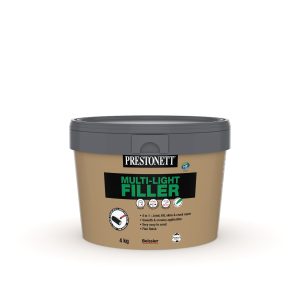
Home - Our products - PRESTONETT INTERIOR FILLER


PRESTONETT INTERIOR FILLER
Powder filler
Use
- Filling
Product advantages:
- Will not shrink crack or slump
- No thickness limitation
- No flashing or grinning
- Lump free easy mix
- Easy to apply
- Easy to sand
- White


Features
- Bag 6 kg
- Box 2 kg
- Box 1 kg
- Wall coverings
- Conventional paint
- Primer
- Concrete
- Cellular concrete
- Cement
- Concrete block
- Brick
- Plaster
- Plasterboard
- Old painted substrates
- Dilution rate : 50%
- Average Consumption : 1 kg of powder fills a volume of 1 liter
- Matériel :


Documentation

Environmental Data
The NF ENVIRONNEMENT certification combines performance and environmental responsibility:
- Guaranteed performance
- Reduced impact on the environment and human health during manufacturing and use, thanks to its composition
For more information, visit www.ecolabels.fr

Information on the level of emission of volatile substances into indoor air, which may pose a risk of toxicity by inhalation, rated on a scale from A+ (very low emissions) to C (high emissions).

99% of raw materials are of natural origin: Natural plaster, calcium carbonate, gelatin, starch
Bags : does not contain recycled paper
100% recyclable
Box : 100% recycled cardboard
100% recyclable

This product contains a maximum of 0.1 g/L VOC

Our PRESTONETT INTERIOR FILLER is made in France at our factory in La Chapelle-la-Reine.

FAQ

A filler such as PRESTONETT INTERIOR FILLER is ideal for filling a large hole in a wall, for interior work and renovation alike. The substrate must be clean, dry, dust-free and sound. If the hole is deep, it is best to dampen it slightly so that the filler does not dry too quickly.
Apply the filler in successive passes, without trying to fill everything in one go. The key is to press the filler firmly into the cavity so that it bonds fully. Once the hole is filled, smooth the surface with a wide blade.
When fully dry, the area can be sanded and then finished with a skimming filler or paint. PRESTONETT INTERIOR FILLER can be applied in thick sections without excessive shrinkage or cracking, which makes it particularly suitable for heavy-duty filling work.
A filler such as PRESTONETT INTERIOR FILLER is not designed to be exposed directly to water or to prolonged humidity. It is formulated for interior work, on dry or slightly damp walls.
If it is used in a humid room (such as a bathroom), make sure the area is not in direct contact with water splashes. Once dry and covered with a suitable paint, however, the filler can withstand a certain level of ambient humidity.
On walls prone to water ingress or rising damp, it is best to deal with the damp problem before applying anything. PRESTONETT INTERIOR FILLER offers excellent mechanical strength, but it has no water-repellent properties.
A filler is the best solution for repairing structural or pronounced cracks, provided the right formulation is chosen. PRESTONETT INTERIOR FILLER is particularly suited to wide cracks, large cracks in walls and open joints.
It can be applied in thick sections, with very good adhesion and low shrinkage on drying. For active or moving cracks, specific treatment with reinforcing tape or a flexible sealant may be needed before application.
If the cracks are fine and not getting worse, a skimming filler is sometimes enough. But as soon as a crack is deep or unstable, PRESTONETT INTERIOR FILLER is the right choice. It ensures a lasting repair and can easily be sanded or overcoated once dry.
A filler such as PRESTONETT INTERIOR FILLER is designed to be applied in thick sections. It has no thickness limitation and can be applied without excessive shrinkage or cracking, which sets it apart from skimming and finishing fillers.
In practice, it is advisable to apply the product in several coats if the thickness exceeds 3 to 4 cm, leaving each pass to dry thoroughly. For small repairs (wall plug holes, surface cracks), a single pass is enough.
Ideally, match the thickness to the size of the defect, without overloading unnecessarily. PRESTONETT INTERIOR FILLER is stable and strong, even on old substrates, which makes it an effective filler for deep interior repairs.
A filler can certainly be applied to a wall that has already been skimmed, provided the substrate is clean, dry, not chalky and firmly bonded. Before application, it is important to check that the old coating is not lifting, crumbling or showing signs of damp.
If in doubt, lightly sand the surface to provide a key. PRESTONETT INTERIOR FILLER can then be used to fill localised defects, complete an existing skim coat or make good holes, even on painted surfaces.
There is no need to strip everything back if the old finish is sound. The product’s adhesion is excellent, even on substrates that have already been prepared or are partly painted.
A filler can crack if it is applied too thickly in a single pass, on an unprepared substrate, or in conditions that are too hot and dry. Natural shrinkage on drying is greater in these cases, which leads to cracks and micro-cracks.
PRESTONETT INTERIOR FILLER limits these risks thanks to its specific formulation, but it is essential to follow the application conditions: lightly dampen the substrate, do not overload the wall, and let it dry naturally without direct heat.
Cracks can also appear if the filler is applied to a moving or damp substrate. Good substrate preparation is therefore essential for a clean, lasting repair.
Filler can be painted directly, provided it is completely dry, sanded and dusted off. It is advisable to apply an undercoat or primer before the finishing coat to even out the absorbency of the wall.
This ensures good paint performance and avoids visible marks or patchiness. PRESTONETT INTERIOR FILLER leaves an even surface once dry, which is easy to work.
If there are any irregularities, light sanding will soften the edges before painting. If the filled area is very visible, you can follow up with a skimming filler to blend in the transition. In all cases, respecting the drying time is essential.
A filler such as PRESTONETT INTERIOR FILLER is sanded once fully dry, generally after 12 to 24 hours depending on the thickness and ambient conditions. For effective sanding, 80 to 120 grit is recommended.
A coarser grit (60) can be used to knock back very thick filler, but it can leave visible scratches. For a clean finish before painting, finish with a finer grit (120 to 150).
It is best to sand by hand with a sanding block, or with a long-reach (giraffe) sander, depending on the area to be treated. PRESTONETT INTERIOR FILLER sands easily without clogging the abrasive, which makes for fast, clean work.
No, hot water does not reduce the drying time. It only shortens the working time of the mix, that is, the time during which the filler remains workable. The overcoating time is unchanged and depends on the thickness, the ambient temperature and the humidity on site.