


Applying filler with a roller is a modern alternative that combines speed with ease of application. Halfway between hand application with a trowel and machine spraying, it involves laying the material on with a dedicated roller, then smoothing it off for an even surface.
It is a good option for professionals renovating an uneven wall or covering an old textured finish without piling on extra coats. All the products on this page can be laid on with a roller, for an even coat and faster work.
Our roller-applied plasters and fillers


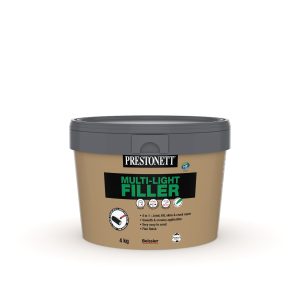
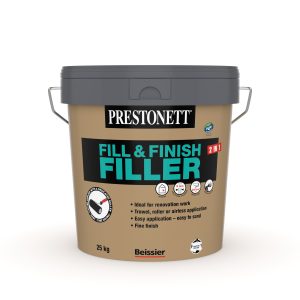
Which fillers can be applied with a roller?
Roller application has many advantages. Roller-applied fillers can be powders or ready mixed pastes; those on this page are all ready mixed. Either way, their consistency must be fluid enough to cling to the roller sleeve and transfer to the substrate, while having enough build to fill surface irregularities.
Some are 2-in-1: PRESTONETT Fill & Finish Filler and BAGAR AIRLISS G level and finish with the same product, so there is no need to switch products between stages. PRESTONETT MULTI-LIGHT FILLER, a ready mixed multipurpose filler, fills up to 8 mm, repairs cracks, levels blockwork and skims surfaces, for a complete renovation from a single bucket. For finishing, BAGAR AIRLISS LF smooths and finishes substrates, and on plasterboard BAGAR AIRLISS J and BAGAR AIRLISS J LIGHT cover every stage of jointing and finishing.
Fillers to suit your substrates
Depending on the product, roller-applied fillers suit a wide range of backgrounds: concrete, cement, brick, plasterboard, old paintwork or old sprinkle effect finishes, and even glass cloth. BAGAR AIRLISS G, PRESTONETT MULTI-LIGHT FILLER and PRESTONETT Fill & Finish Filler accept all of these, while BAGAR AIRLISS J and BAGAR AIRLISS J LIGHT are for plasterboard. They are all white, generally easy to sand and can be overcoated with primer, conventional paint or lightweight wall coverings.
Using a roller saves considerable time: the coat goes on evenly, there is less fatigue and working at height is easier with an extension pole.
How to apply filler with a roller
As with any application, preparing the substrate is essential: it must be sound, dry and clean. Protect floors and any surfaces not being treated with suitable protective tape. Stir the filler before use, thinning it by up to 3% if necessary, then load the roller to prime the sleeve.
Lay on a generous coat over an area of about one square metre, working in criss-cross passes to spread the material evenly. Reload the roller regularly to keep the thickness constant. Immediately after laying on, go over the surface with a skimming blade or smoothing trowel; this pushes out air bubbles and levels the filler for an even first coat.
Once the surface is dry, sand any irregularities locally and dust off before applying a second coat, thicker if the substrate is very uneven, while keeping within the application thickness on the data sheet: 3 mm for BAGAR AIRLISS LF, BAGAR AIRLISS J and BAGAR AIRLISS J LIGHT, 5 mm for BAGAR AIRLISS G and PRESTONETT Fill & Finish Filler, 8 mm for PRESTONETT MULTI-LIGHT FILLER. Leave each coat to dry as stated for the product used: with every product on this page, the next coat goes on once the previous one is completely dry.
The benefits of roller application
Roller-applied filler offers an excellent balance between output and control. It covers large areas quickly while letting you control precisely how much material goes on. Simple to use, it is quick to pick up, even for operatives with little skimming experience, provided they use a suitable roller and the right technique.
This application method makes the work less physically demanding, thanks to even laying on and quick smoothing.