


Lightweight fillers combine high filling power with easy application. Their lower density means they spread with less effort, go further per square metre and keep shrinkage under control as they dry.
In new build and renovation alike, lightweight fillers are used to bring surfaces back to flat, take out minor unevenness and prepare an even surface before priming and painting. Their fine finish and easy sanding make a clean result easier to achieve, while keeping the amount of finish needed in check.
Our lightweight fillers and jointing compounds


What is a lightweight filler?
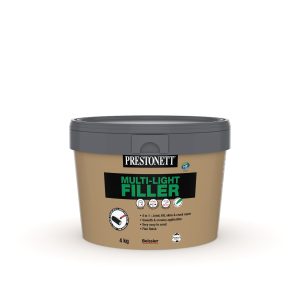
A lightweight filler is formulated with special mineral fillers that lower its density without sacrificing cohesion. This combination lets you apply a useful thickness per pass, with a smooth, easy spread and little drag. Low shrinkage means fewer touch-ups and visible lap marks, and a white finish helps the paint cover. The three products on this page are ready mixed and white, with a density of 0.4 for PRESTONETT LIGHT WEIGHT FILLER, 1.2 for BAGAR AIRLISS J LIGHT and 1.3 for PRESTONETT MULTI-LIGHT FILLER.
Depending on the product, these fillers are used on prepared substrates such as plasterboard, plaster, concrete and sound old painted substrates, for light levelling, skimming or finishing over taped joints. PRESTONETT LIGHT WEIGHT FILLER can also be used outdoors and on previously primed wood, while BAGAR AIRLISS J LIGHT is for plasterboard only. They are applied by hand with a filling knife, blade or smoothing trowel; PRESTONETT MULTI-LIGHT FILLER and BAGAR AIRLISS J LIGHT can also be laid on with a dedicated roller and then smoothed. BAGAR AIRLISS J LIGHT can also be applied with a banjo, or sprayed with an airless machine and smoothed straight away for an even thickness.
When to use a lightweight filler, and how to choose one
Choose a lightweight filler when speed and comfort come first: ceilings, high walls, large areas, or jobs where a lighter load means less fatigue. They are particularly recommended for taking out orange peel, hiding joint lines that show through the paint and getting a tight, smooth surface before demanding finishes.
To pick the lightweight filler that best fits the job, focus on 4 simple criteria:
- Density and ease of spreading, to reduce effort and keep each pass consistent.
- Thickness per coat, according to how much the surface needs straightening.
- Consistent sanding, with little clogging of abrasives.
- Compatibility with the application method (by hand, roller or machine) and the planned finish.
The three products at a glance
- PRESTONETT LIGHT WEIGHT FILLER: density 0.4, for interior and exterior use. Fills holes and cracks of all sizes, at any thickness, filling and finishing in a single pass. Does not shrink or crack, is very easy to sand and gives a very fine finish. Applied by hand with a filling knife or blade, on concrete, cellular concrete, cement, concrete block, brick, plaster, plasterboard, previously primed wood and old painted substrates. 750 ml bucket.
- PRESTONETT MULTI-LIGHT FILLER: density 1.3, for interior use. A 4-in-1 product for taping and jointing plasterboard, filling up to 8 mm, crack repair, levelling blockwork and skim coating, and goes on very smoothly. Applied with a filling knife, blade or dedicated roller, on concrete, cellular concrete, cement, concrete block, brick, plaster, plasterboard and old painted substrates, as well as old sprinkle effect and glass cloth. 4 kg and 12 kg buckets.
- BAGAR AIRLISS J LIGHT: density 1.2, for interior use on plasterboard. A spray-applied plaster, finishing and jointing compound for all stages of plasterboard jointing and finishing and for fixing corner tapes and beads, applied up to 3 mm. Used by hand (smoothing trowel, blade), with a dedicated roller or banjo, or sprayed with an airless machine; suitable for use with all automated taping and jointing tools. 18 kg bucket.
Application method and good practice
To get the best from a lightweight filler, start by preparing the substrate: it must be hard, cohesive, clean, sound, dry and free of dust. Stir the product before use: PRESTONETT MULTI-LIGHT FILLER is mixed at low speed, and both it and BAGAR AIRLISS J LIGHT can be thinned with up to 3% water if necessary. Apply in criss-cross passes, then flatten off with a wide skimming blade, keeping to the maximum thickness per coat and the drying times. Once the filler is completely dry, sand lightly with a fine abrasive, dust off, then apply a suitable primer before painting. Apply PRESTONETT MULTI-LIGHT FILLER and BAGAR AIRLISS J LIGHT between 8°C and 35°C at no more than 70% relative humidity, and PRESTONETT LIGHT WEIGHT FILLER between 5°C and 35°C at no more than 80%.
The benefits of lightweight fillers
Lightweight fillers have plenty going for them: they reduce effort, speed up levelling and make the result more reliable, with consistent flatness, an even white colour and controlled paint consumption.
Controlled shrinkage cuts down on touch-ups, predictable sanding keeps the programme on track, and because they suit different application methods, you can match output precisely to the size of the job: by hand, by roller or, with BAGAR AIRLISS J LIGHT, by airless spraying. The result is a smooth, durable surface, ready for a high-quality finish.