


Fillers and jointing compounds for plasterboard give a seamless finish across the boards, bring the joints flush and prepare the surface for priming and painting.
Whether for new joints, local repairs or a complete refurbishment, they must combine reliable adhesion, smooth, even spreading and predictable sanding, while limiting shrinkage. Their role is first and foremost technical: to bond the joints, fill and skim, leaving a flat, uniform surface that meets the standard expected of today’s finishes.
Our fillers and jointing compounds for plasterboard




What is a plasterboard filler?
A plasterboard filler is a compound with a carefully graded particle size, designed for three complementary uses. First comes bedding and filling: the compound soaks into the paper or metal-reinforced tape, covers the tape so it does not stand proud and stabilises the joint, whether a tapered edge or a butt joint. Skimming then improves flatness, removes tool marks and closes the surface before the undercoat. Finally, a very fine finishing coat evens out the appearance and leaves a smooth, clean surface.
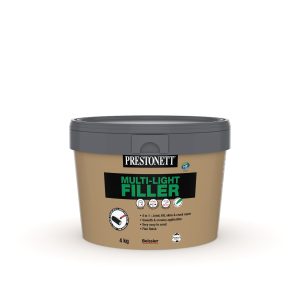
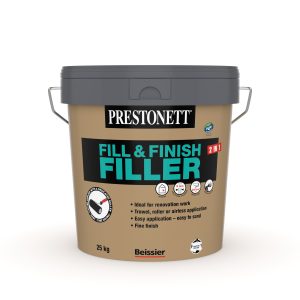
BAGAR AIRLISS J and BAGAR AIRLISS J LIGHT cover every stage of plasterboard jointing and finishing, from bedding the tape to the final coat, and are also used for fixing corner tapes and beads. PRESTONETT MULTI-LIGHT FILLER and PRESTONETT MULTIPURPOSE FILLER can also be used for taping and jointing. All four are jointing materials for gypsum plasterboards to EN 13963 (Type 3A; Type 4B for PRESTONETT MULTIPURPOSE FILLER). For skimming, BAGAR AIRLISS LF finishes and smooths the surface, while BAGAR AIRLISS G and PRESTONETT Fill & Finish Filler level and finish in one product. For the final, very fine pass, PRESTONETT FINE SURFACE FILLER is applied at 1 mm.
Depending on the product, they can be used on plasterboard, on plaster and on sound old paintwork after preparation; BAGAR AIRLISS J and BAGAR AIRLISS J LIGHT are for plasterboard only. They give a comfortable open time to bed the tape without air bubbles, then harden evenly to take the following coats.
Depending on the job, they are applied with a filling knife or a wide blade, laid on with a roller and then smoothed, or applied by machine. All the BAGAR AIRLISS products on this page, PRESTONETT MULTI-LIGHT FILLER and PRESTONETT Fill & Finish Filler can be applied by roller. For taping, BAGAR AIRLISS J and BAGAR AIRLISS J LIGHT are suitable for use with all automatic taping and jointing tools, such as the banjo, bazooka, Mudshot or flat boxes. For skimming, BAGAR AIRLISS LF, BAGAR AIRLISS J, BAGAR AIRLISS J LIGHT, BAGAR AIRLISS G and PRESTONETT Fill & Finish Filler can be sprayed with an airless machine; BAGAR AIRLISS J and BAGAR AIRLISS J LIGHT can also be sprayed for joint filling.
When to use a plasterboard filler and how to choose one
Plasterboard fillers are used from the moment the boards are fixed, on tapered-edge and butt joints, and on internal and external corners with suitable tapes or beads. They are also useful in renovation to remove orange peel, take out minor unevenness or hide joint lines showing through the paint.
The choice depends on the programme on site, the humidity and the application method. A ready mixed product gives a consistent texture and saves time; a powder with a controlled set, such as PRESTONETT INTERIOR FILLER (working time about 35 minutes) or PRESTONETT MULTIPURPOSE FILLER (about 60 minutes), lets you pace the work room by room. The thickness allowed per pass guides the initial levelling (3 mm for BAGAR AIRLISS J and BAGAR AIRLISS J LIGHT, 5 mm for BAGAR AIRLISS G and PRESTONETT Fill & Finish Filler, 8 mm for PRESTONETT MULTI-LIGHT FILLER), while the fineness of the grain and ease of sanding determine the final finish. Check compatibility with the tape, the primer and any spray-applied paint, to avoid blistering and differences in suction.
How to apply a plasterboard filler
Applying a plasterboard filler calls for a rigorous method: prepare and dust off the substrate, bed and press in the tape carefully, fill without leaving excess thickness, skim in criss-cross passes and allow the full drying times, sand with a fine abrasive, then apply a primer to even out the suction before the finish.
With BAGAR AIRLISS J, the data sheet sets out the taping sequence:
- apply the compound liberally in the recess between the tapered edges of the boards;
- place the roughened (or labelled) side of the joint tape on the compound;
- press the tape into place and remove the surplus;
- using a float, smooth compound over the tape;
- leave this coat to dry;
- apply a finishing coat to the joint with a trowel, 5 cm beyond the taper on either side.
Well chosen and correctly applied, plasterboard fillers give a flat, evenly white surface and keep paint consumption under control, while ensuring the work lasts.