


Fillers for plaster and plaster-based substrates even out wall and ceiling surfaces, correct cosmetic defects and leave them ready to prime and paint.
Suitable for walls and ceilings in traditional gypsum plaster and other gypsum-based finishes, they combine good filling power, smooth, even spreading and predictable sanding. In new build and renovation alike, they ensure a flat surface, limit shrinkage as they dry and give an even white base for high-quality paint finishes and lightweight wall coverings.
Our fillers for plaster




What is a filler for plaster?
In practice, these fillers are formulated for gypsum-based substrates: they spread without tearing and bond to properly prepared backgrounds.
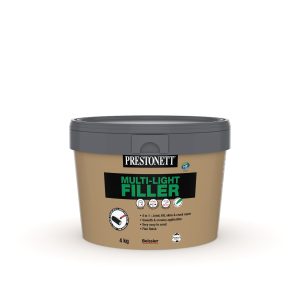
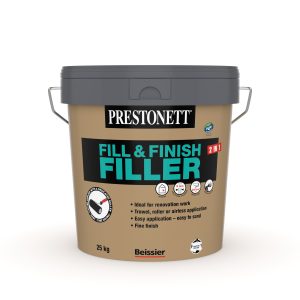
Depending on the job, there are three types. Levelling products even out the surface (scratches, joins between passes, small hollows): BAGAR AIRLISS G and PRESTONETT Fill & Finish Filler level and finish in one product, up to 5 mm. Skimming products, such as BAGAR AIRLISS LF or PRESTONETT MULTI-LIGHT FILLER, give a smooth, closed surface with a fine finish. Very fine finishing products take out the last marks before painting: PRESTONETT FINE SURFACE FILLER, applied at 1 mm, hides small defects and enhances the paint finish.
Powder fillers with a controlled set, mixed with water on site, let you pace the work room by room: PRESTONETT MULTIPURPOSE FILLER, for example, has a working time of about 60 minutes. Ready mixed products give a consistent texture and can be used straight away.
When to use a filler on plaster and how to choose one
Use a filler as soon as the plaster shows visible defects: scuffs, tool marks, orange peel, uneven areas between patches, or filled areas that need blending in. The choice depends on four factors:
- Condition of the background: on sound, dry plaster, careful preparation (dusting off, keying where needed, regulating suction) is the key to good adhesion. All the products on this page require a hard, cohesive, clean, sound and dry substrate.
- Level of correction: for marked unevenness, choose a filler that can be applied thickly without slumping, such as PRESTONETT INTERIOR FILLER, which has no thickness limitation; for the final pass, a very fine finishing filler.
- Application method: by hand for precise local work; roller or machine for speed on large areas.
- Timing and conditions: choose the open time and setting time to suit the temperature, humidity and programme on site. The data sheets set the limits: 8°C to 35°C at no more than 70% relative humidity for the interior-only products, 5°C to 35°C at no more than 80% for those suitable for exterior use. For minor repairs, PRESTONETT QUICK DRY FILLER can be sanded and painted after 15 minutes, depending on the substrate and atmospheric conditions.
Applying filler to plaster
Apply the filler with a filling knife or a wide blade. On large areas, applying with a roller and smoothing off straight away, or machine application with the products that allow it, gives high output and an even thickness. BAGAR AIRLISS LF, BAGAR AIRLISS G, PRESTONETT MULTI-LIGHT FILLER and PRESTONETT Fill & Finish Filler can be applied by roller; BAGAR AIRLISS LF, BAGAR AIRLISS G and PRESTONETT Fill & Finish Filler can be sprayed with an airless machine, and BAGAR AIRLISS G can also be applied with a screw pump.
After assessing and preparing the background (cohesive, dry and dust-free), apply the filler in criss-cross passes, keeping to the maximum thickness per coat. Smoothing with a wide blade evens out the texture. Let it dry completely, then sand with a fine abrasive and dust off thoroughly. A primer then evens out the suction before painting.
Correctly chosen and applied, a filler for plaster gives a surface that stays flat, helps the paint system cover better and keeps product consumption under control, for a clean, durable finish without waste.