


Fillers for holes and cracks make good defects in the substrate itself, before it is levelled, skimmed and painted. Their job is to fill holes, cracks, chases and chipped areas, and to leave a solid, stable surface.
Formulated with high-build mineral fillers and low-shrinkage binders, they do not slump and give lasting adhesion; depending on the product, the repair can also be drilled or take a wall plug once dry. Indoors, they are used on plasterboard, plaster, concrete and masonry, and the range on this page also covers exterior work and woodwork.
Some are quick drying, so you can fill, sand and paint the same day: PRESTONETT EXTERIOR QUICK DRY FILLER can be overcoated after about 3 hours at 20°C, and PRESTONETT QUICK DRY FILLER is ready to sand and paint in 15 minutes, depending on the substrate and conditions. Many are ready mixed, so you can start straight away with no mixing and get a consistent texture every time.
Our fillers for holes and cracks




What is a filler for holes and cracks?
A filler for holes and cracks is a repair compound designed to fill areas where material is missing. Its grain size and cohesion allow a good build in each pass, while limiting shrinkage and the need to go back over the repair. Powder versions are mixed on site, so you can adjust the consistency and setting time to the temperature and humidity. On this page, PRESTONETT INTERIOR FILLER, PRESTONETT EXTERIOR QUICK DRY FILLER, PRESTONETT MULTIPURPOSE FILLER, PRESTONETT WATERPROOF MASONRY FILLER and PRESTONETT WOOD REPAIR are powders, with working times of about 30 to 60 minutes at 20°C.
Ready mixed versions give a consistent texture and are easy to work with, and all those on this page have an unlimited working time. Some formulations are reinforced to stabilise the edges of cavities and make later drilling more secure. The aim is a flat background, hard right through and compatible with the coats that follow.
Substrates and thicknesses
Before applying the filler, make sure the substrate is clean, sound and free of dust. Very absorbent substrates benefit from a suitable primer to regulate their absorbency. Fill accurately, without overloading, building up in successive layers where the hole is deep, to avoid delayed shrinkage. Accurate levelling makes skimming easier and reduces the amount of filler needed at the following stages.
All the wall and masonry fillers on this page can be used on concrete, cellular concrete, cement, concrete block and brick. PRESTONETT INTERIOR FILLER, PRESTONETT MULTIPURPOSE FILLER and the ready mixed wall fillers can also be used on plaster, plasterboard and old painted substrates. PRESTONETT EXTERIOR QUICK DRY FILLER, PRESTONETT WATERPROOF MASONRY FILLER and PRESTONETT MULTIPURPOSE FILLER are also suitable for stone and mortars. The three wood fillers are for most types of wood, including chipboard and plywood, and PRESTONETT LIGHT WEIGHT FILLER can also be used on previously primed wood. The maximum thickness per application ranges from 3 mm to no limit, depending on the product (see the guide below).
When and how to use a filler for holes and cracks
Filling is needed as soon as the defects are beyond what a skimming filler can correct. In everyday renovation, it comes in after old fixings have been removed, when service chases are made good, or when damaged corners are repaired.
The method is simple: assess and prepare the background, dampen it lightly if necessary, press the filler firmly into the cavity, working off the sound edges, then strike off flush with the surrounding surface using a blade. Once the filler is completely dry, sand evenly to remove any excess and dust off, then follow on with a levelling or skimming filler and a primer.
Choosing a filler for holes and cracks
Professionals look at four criteria when selecting the filler that best suits the job: the thickness allowed per pass, a setting or drying time that fits the programme on site, ease of sanding, and compatibility with the substrate.
The products on this page at a glance:
- PRESTONETT INTERIOR FILLER: powder, interior. No thickness limitation; will not shrink, crack or slump, and is easy to sand. Working time about 35 minutes.
- PRESTONETT MULTIPURPOSE FILLER: powder, interior. Fills up to 5 cm in one application and will not shrink, crack or slump. Working time about 60 minutes.
- PRESTONETT EXTERIOR QUICK DRY FILLER: fibre-enriched powder for exterior use. Fills holes and cracks up to 4 cm, in layers of at least 2 mm, and can be overcoated after about 3 hours at 20°C.
- PRESTONETT WATERPROOF MASONRY FILLER: grey powder for interior and exterior masonry. Fills up to 15 mm in one application and is waterproof from 3 mm thick. Overcoat after 48 hours.
- PRESTONETT READY MIXED FILLER: ready mixed, interior and exterior. For small holes and cracks up to 1 cm; dries hard, is easy to sand and needs no spot priming.
- PRESTONETT LIGHT WEIGHT FILLER: lightweight and ready mixed, interior and exterior. For holes and cracks of all sizes, at any thickness; fills and finishes in a single pass and is very easy to sand.
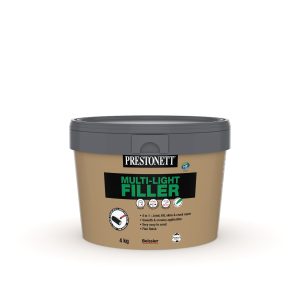
- PRESTONETT MULTI-LIGHT FILLER: lightweight and ready mixed, interior. Fills small holes and cracks up to 8 mm, with a filling knife, blade or dedicated roller.
- PRESTONETT QUICK DRY FILLER: ready mixed in a 200 ml tube, interior and exterior. For minor surface repairs up to 3 mm; water and humidity resistant, ready to sand and paint in 15 minutes depending on conditions.
- PRESTONETT WOOD FILLER: ready mixed, interior and exterior. Fills and skims small holes, cracks and minor imperfections in wood, up to 1 cm.
- PRESTONETT WOODFILLER (TUBE): flexible, fibre glass reinforced and quick drying, interior and exterior. For holes and cracks in doors, window frames, skirting boards and floorboards, up to 5 mm. Do not apply on damp wood; outdoors, overcoat with a weatherproof stain, varnish or paint.
- PRESTONETT WOOD REPAIR: powder, interior and exterior. Any thickness; rebuilds wood lost to decay and is ideal for repairing broken corners. Very hard when dry, it can be carved and drilled.
In areas exposed to knocks and wear, a formulation with very low shrinkage and high adhesion gives a repair that lasts. Well chosen and correctly applied, a filler for holes and cracks restores the line and level of the substrate, speeds up preparation and gives a sound base for a flawless finish.