


Plasters and fillers for glass cloth hide the texture of glass fibre wallcoverings, make good visible seams and give an even appearance before priming and painting. Rather than stripping the wallcovering, a slow job with uncertain results, they fill the weave, even out absorbency and leave a flat surface ready for paint.
They are formulated to bond reliably to painted or unpainted glass cloth, with controlled shrinkage and even sanding, for a tight, durable finish.
Our plasters and fillers for glass cloth


What is a filler for glass cloth?
It is a preparation filler made for glass fibre wallcoverings, with a grain and consistency that allow it both to fill the weave and to give a fine skim. The filler spreads without pulling at the fibres, stays open long enough to work wet on wet and hardens evenly, ready for the next coats.
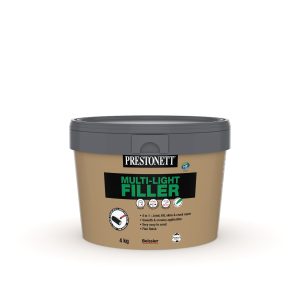
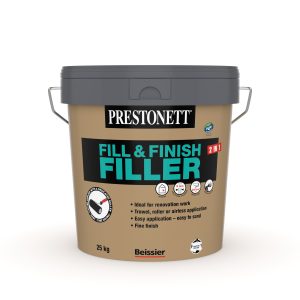
Depending on the job, filler is applied to glass cloth with a filling knife and blade, laid on with a dedicated roller and smoothed straight away where the product allows, or sprayed with an airless machine and flattened off with a blade for an even thickness. BAGAR AIRLISS G, PRESTONETT MULTI-LIGHT FILLER and PRESTONETT Fill & Finish Filler can be applied by roller, BAGAR AIRLISS G and PRESTONETT Fill & Finish Filler can be sprayed, and PRESTONETT MULTIPURPOSE FILLER is applied by hand.
When to skim glass cloth, and how to prepare it
Use these products when glass cloth in good condition has an obtrusive texture, visible seams, patches from earlier work or orange peel built up over successive repaints.
Important: to skim glass cloth, the surface must be prepared before the filler goes on. Before you start, check that the wallcovering is firmly bonded, degrease and dust off, re-stick any open seams, then lightly sand down any local build-up. On mixed backgrounds (matt and satin areas), a primer can help even out absorbency before skimming.
Applying the filler to glass cloth
The first coat on glass cloth is a filling coat that buries the weave. Work in criss-cross passes, keeping to the maximum thickness per coat and to the drying times. Once it has hardened, a light sand with a fine abrasive prepares the surface for the second, skimming coat, which removes the last marks and leaves a tight skim. A third, localised skim can help where a very high standard of finish is required. Finish by dusting off, applying a suitable primer, then painting.
Points to watch and how to choose a filler
A few precautions help in choosing the right filler for glass cloth. Use a high-build filler for the first coat and a fine-grained one for the second, with controlled shrinkage and even sanding. Check that it suits the application method (hand, roller or machine) and the planned finish. Avoid build-up over the seams, and protect the surroundings: cutting or sanding glass cloth can release fine particles, so keep sanding under control and use effective dust extraction.
The four products on this page:
- High build: PRESTONETT MULTIPURPOSE FILLER, a powder, fills up to 5 cm in one application and will not shrink, crack or slump. PRESTONETT MULTI-LIGHT FILLER, lightweight and ready mixed, fills up to 8 mm and is also used for skim coating, with a fine finish.
- One product for both coats: BAGAR AIRLISS G and PRESTONETT Fill & Finish Filler level and finish up to 5 mm, by hand, roller or airless machine.
- Overcoating: once completely dry, all four take a primer, conventional paint or a lightweight wall covering.
The benefits of skimming over glass cloth
Choosing a filler to apply over glass cloth brings several benefits. Skimming over the wallcovering saves time, avoids the unknowns of stripping it and improves paint opacity, often reducing the number of coats. The flatness achieved shows off the finish, consumption stays under control and, with machine application, a consistent thickness keeps the job on schedule.
The result: a smooth, sound and durable surface, ready for a quality finish.