


Fillers for blockwork are made for the particular demands of an uneven mineral substrate: concrete blocks laid with mortar joints, which often absorb at different rates.
Their job is to bring the wall back to a flat surface, close up its texture and even out its appearance before priming and finishing. Formulated to bond to cement-based backgrounds and keep shrinkage to a minimum, they spread without dragging, most of them sand easily, and they leave a flat, cohesive base in renovation and new build alike. Where the wall moves, PRESTONETT FLEXIBLE CRACK REPAIR FILLER, highly flexible and fibre reinforced, is designed for cracks that keep coming back.
Our plasters and fillers for blockwork




What is a filler for blockwork?
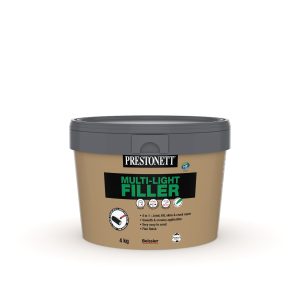
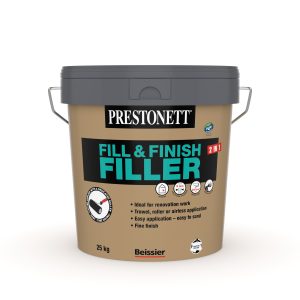
A filler for blockwork is a preparation product with plenty of build, able to fill recessed joints and take out irregularities in the blocks. It holds together through its full depth, so it can go on thicker than a simple skimming filler without slumping or cracking, provided it is applied correctly. PRESTONETT MULTI-LIGHT FILLER, for example, is designed for levelling block work and fills up to 8 mm, and PRESTONETT Fill & Finish Filler levels uneven surfaces up to 5 mm.
Depending on the aim, start with a levelling pass to bring the wall flat, then a fine-grained skim to leave a tight surface before priming and painting; BAGAR AIRLISS G and PRESTONETT Fill & Finish Filler do both jobs with one product. Water vapour permeability is an important criterion, so as not to trap residual moisture in the masonry: BAGAR AIRLISS EXT, PRESTONETT EXTERIOR QUICK DRY FILLER and PRESTONETT WATERPROOF MASONRY FILLER are water vapour permeable.
When to use a filler for blockwork, and how to prepare the wall
Preparing the background
The result depends on methodical preparation: remove loose material, brush down and dust off, dry-brush off efflorescence, cut back unsound areas and make good any missing sections. A simple absorbency test (a drop of water) helps you decide whether very porous areas need a suitable primer first. Moving cracks are opened up, cleaned out and filled in line with good practice to stabilise the background before skimming. PRESTONETT FLEXIBLE CRACK REPAIR FILLER repairs recurring cracks caused by structural movement, applied up to 3 mm thick, without fibre tape or fabric. For missing sections and deep holes, PRESTONETT EXTERIOR QUICK DRY FILLER fills up to 4 cm outdoors and PRESTONETT MULTIPURPOSE FILLER up to 5 cm in one application indoors.
Weather conditions
Take care: the weather affects how any filler performs. Do not apply to a frozen background, in full sun or in strong wind. Outdoors, protect the work from run-off while it sets and dries; indoors, ventilate well enough to help evaporation, without creating draughts. Depending on the product, the data sheets set application conditions at 5°C to 35°C with relative humidity up to 80%, or 8°C to 35°C with relative humidity up to 70%.
Application methods for blockwork fillers
On small and medium areas, applying the filler by hand with a filling knife or a wide blade gives precise control over thickness; every product on this page can be applied by hand. To speed things up, a dedicated roller spreads the material evenly before smoothing: BAGAR AIRLISS G, PRESTONETT MULTI-LIGHT FILLER and PRESTONETT Fill & Finish Filler can be applied this way. On large areas, a screw pump or a spray machine gives high output and a consistent thickness, and some products can be sprayed with an airless machine and then smoothed straight away with a blade. By machine, BAGAR AIRLISS G can be applied with an airless machine or a screw pump, BAGAR AIRLISS EXT with an airless or spray machine, and PRESTONETT Fill & Finish Filler with an airless machine.
Choosing the filler depends on the size of the defects (the thickness allowed per coat), the standard of finish expected, exposure (interior or sheltered façade) and the pace of the job. Always keep to the thickness per coat and the drying times, and sand to even out the surface before dusting off and priming.
The products on this page, by job:
- Levelling and skimming interior block walls: PRESTONETT MULTI-LIGHT FILLER (ready mixed, lightweight, designed for levelling block work, fills up to 8 mm, skim coating by roller, trowel or blade), PRESTONETT Fill & Finish Filler (fills and finishes, levels uneven surfaces up to 5 mm, 25 kg bucket) and BAGAR AIRLISS G (levelling and finishing in one product, 5 mm, 1 to 3 kg/m²).
- Exterior blockwork: BAGAR AIRLISS EXT (grey exterior leveller, 5 mm, water and humidity resistant, can be overcoated with exterior paint) and PRESTONETT WATERPROOF MASONRY FILLER (grey powder, interior and exterior, fills up to 15 mm in one application, waterproof from 3 mm thick).
- Missing sections and deep holes: PRESTONETT EXTERIOR QUICK DRY FILLER (powder, exterior, up to 4 cm, can be overcoated after about 3 hours at 20°C), PRESTONETT MULTIPURPOSE FILLER (powder, interior, up to 5 cm in one application), PRESTONETT INTERIOR FILLER (powder, interior, any thickness) and PRESTONETT LIGHT WEIGHT FILLER (ready mixed, interior and exterior, any thickness, fills and finishes in a single pass).
- Small holes and cracks: PRESTONETT READY MIXED FILLER (ready mixed, interior and exterior, up to 1 cm) and PRESTONETT QUICK DRY FILLER (minor surface repairs up to 3 mm, ready to sand and paint in 15 min depending on substrate and conditions).
- Moving cracks: PRESTONETT FLEXIBLE CRACK REPAIR FILLER (highly flexible and fibre reinforced, applied up to 3 mm thick, interior and exterior).
For aircrete (cellular concrete) blocks, every product on this page except BAGAR AIRLISS EXT also lists cellular concrete among its substrates.
The benefits of blockwork fillers for professionals
Well chosen and correctly applied, a filler for blockwork evens out colour and texture, helps stop the joint pattern grinning through and improves the opacity of the paint system, which cuts consumption and the number of coats. A smooth glide limits fatigue, low shrinkage keeps the background stable, and the choice of application methods lets you match output to the size of the job. The result: a flat, sound and durable base, ready for the finish.