


Airless plasters are designed to be applied by airless spraying, using high-pressure airless machines. This method covers large areas quickly, lays down a perfectly even coat and is less tiring for the operative.
Plasters formulated for airless application have a specific texture: they spray with little overspray, spread under the blade without air bubbles and sand evenly. They are particularly suited to large-scale jobs where output and a consistent final appearance are essential.
Our airless plasters and fillers


What is an airless plaster?
It is a fine-grained ready mixed paste suited to pumping and high-pressure spraying with an airless machine. Its viscosity and flow are set so that it passes through the tip without separating, then forms a dense, continuous coat on the substrate. Once sprayed, the plaster is immediately flattened off with a wide blade to smooth the surface and control the thickness.
Airless plasters are used indoors on prepared substrates such as plasterboard and plaster, concrete and concrete-based substrates, or sound old paintwork. Their formulation gives a smooth, firm, white skim that closes up the surface of the substrate and evens out absorbency before priming and painting. On plasterboard, BAGAR AIRLISS J and BAGAR AIRLISS J LIGHT can be sprayed for joint filling as well as for finishing, with a tip size of up to 3.33 for joint filling.
For exterior work, Beissier also offers an airless plaster: BAGAR AIRLISS EXT, a ready mixed spray-applied leveller that is also suitable for finishing the undersides of balcony slabs before decoration and for levelling contraction/control joints in concrete. It is grey and takes exterior paint.
Preparation and application
To get the most out of airless spraying, site preparation is crucial. The substrate must be sound, clean and free from dust; the data sheets also require it to be hard, cohesive and dry. Very porous areas, or areas of mixed porosity, may need sealing first so that the finish does not look patchy.
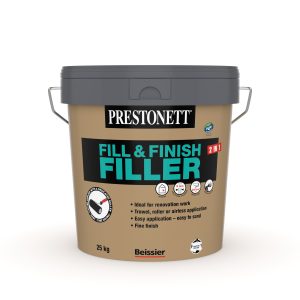
The ready mixed plaster is stirred, thinned by up to 3% if necessary, then poured into the machine hopper. Pressure and tip are set as recommended to obtain an even spray pattern: the Bagar data sheets specify an airless machine delivering 5 l/min, with no strainer or filter needed, and give the maximum tip size for each product (5.31 for BAGAR AIRLISS G, for example). Spray in criss-cross passes, keeping a constant distance from the wall. Immediately after spraying, flatten off with a wide blade or knife to smooth the material and control the thickness. Respect the application thickness given on each data sheet: 3 mm for BAGAR AIRLISS LF, BAGAR AIRLISS J and BAGAR AIRLISS J LIGHT, 5 mm for BAGAR AIRLISS G, BAGAR AIRLISS EXT and PRESTONETT Fill & Finish Filler. Also respect the ambient conditions, which affect drying: do not apply below 8°C or above 35°C, or above 70% relative humidity (for BAGAR AIRLISS EXT: not below 5°C or above 35°C, or above 80% RH).
Once completely dry, a light sand with a fine abrasive removes any irregularities; dust off, then apply a suitable primer (BAGAR AIRLISS EXT is overcoated with exterior paint).
Why choose an airless plaster?
The technique has several advantages for professionals. Airless spraying gives very high output, especially on ceilings and large wall areas. The thickness applied is even, which cuts down on touching up and gives a consistently flat surface. Plasters designed for airless glide well under the blade, reduce fatigue and sand easily, for a clean, consistent result. Machine application also lets you work from large buckets and bags, so there are fewer stops to refill the machine: the products on this page come in 25 kg packs, apart from BAGAR AIRLISS J LIGHT, sold in 18 kg buckets.
With airless plasters, you stay in control of your schedule, save paint thanks to an even white surface (all the interior products on this page are white) and deliver a flawless finish on demanding jobs.